Bathroom Ventilation: Why Your Exhaust Fan Needs to Do More Than Just Run
Bathroom ventilation is one of those parts of a home that often gets overlooked. You turn on the exhaust fan, hear it running, and assume everything is working properly.
But a bathroom fan that runs is not necessarily a ventilation system that is working as intended.
During a home inspection, I look beyond whether the bathroom exhaust fan simply turns on. The fan, ductwork, insulation, exterior termination and backdraft damper all need to work together to remove moisture while limiting unwanted air movement.
That becomes particularly important in Newfoundland homes, where our cold winters, wind and temperature differences can expose problems with poorly installed or poorly sealed ventilation systems.
Why Is Bathroom Ventilation So Important?
Every shower or bath releases moisture into the air.
Without adequate ventilation, that warm, humid air can remain in the bathroom or migrate into other areas of the home.
Over time, excessive bathroom moisture can contribute to:
- Peeling or bubbling paint
- Ceiling and wall staining
- Deterioration of drywall and finishes
- Condensation on windows and cold surfaces
- Elevated indoor humidity
- Mold or mildew-like growth
- Moisture entering the attic or concealed building cavities
A properly installed bathroom exhaust system should capture this moisture and discharge it completely to the exterior of the home.
Bathroom exhaust should not terminate inside the attic.
The Exhaust Duct Is Just as Important as the Fan
Installing a good bathroom fan is only part of the job.
The duct connected to it also needs to be properly installed.
Ideally, the exhaust duct should have a reasonably short and direct route to the exterior. Connections should be secure, and ductwork passing through an unconditioned attic should be appropriately insulated.
That insulation becomes especially important during a Newfoundland winter.
Warm, moisture-laden bathroom air travelling through a cold attic can cool rapidly. If the exhaust duct isn’t adequately insulated, condensation can develop inside it.
That moisture may collect within the duct, reduce airflow or potentially find its way back toward the fan.
Why Is Cold Air Coming Through My Bathroom Fan?
If you feel a cold draft coming through your bathroom exhaust fan during the winter, the backdraft damper is one of the components that should be checked.
Think of a backdraft damper as a one-way door.
When the bathroom fan operates, airflow opens the damper and allows humid bathroom air to leave the home.
When the fan shuts off, the damper should close.
If the damper is missing, damaged, stuck open or not sealing properly, the exhaust duct can provide a pathway for unwanted air movement.
During a Newfoundland winter, that may mean cold exterior air entering through the bathroom exhaust system.
During warmer conditions, unwanted heat from the exterior or attic environment may also become noticeable around an improperly sealed fan or duct assembly.
Why Am I Seeing Heat Around My Bathroom Exhaust Fan?
This is where thermal imaging during a home inspection can provide useful additional information.
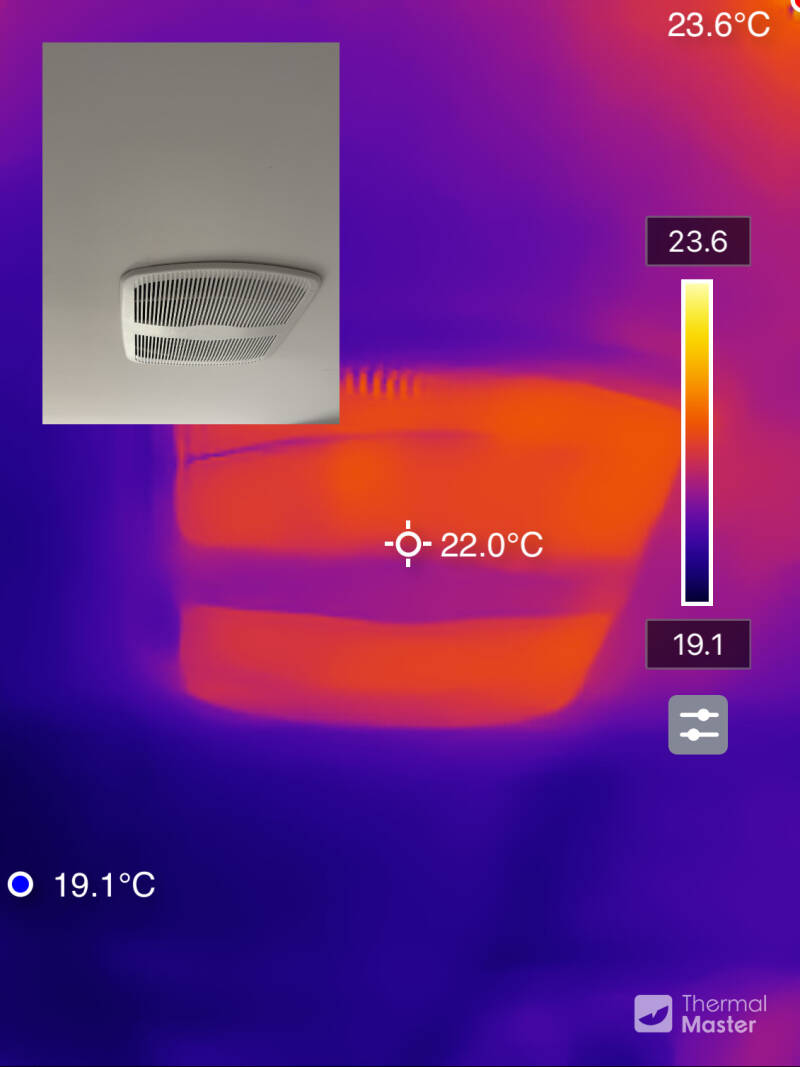
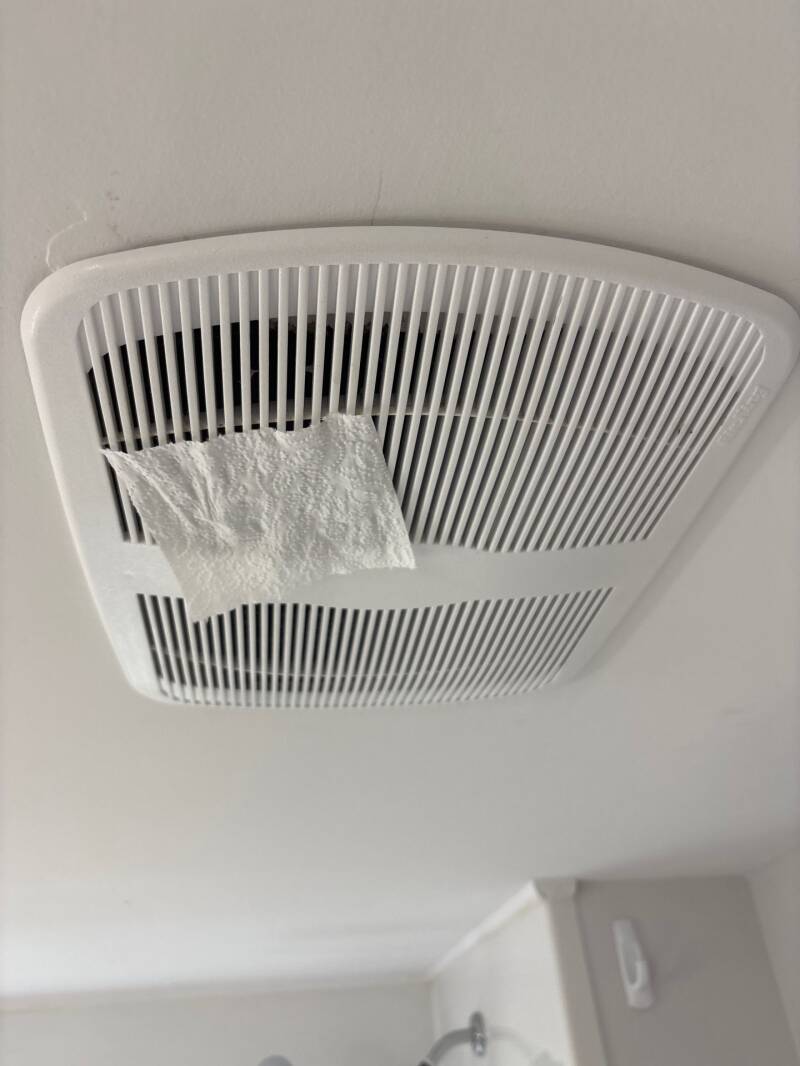
The thermal image accompanying this article shows a noticeable temperature pattern around a bathroom exhaust fan.
An infrared camera doesn’t see through ceilings or automatically tell us exactly what is wrong.
Instead, it shows surface-temperature differences that may warrant additional investigation.
An unusual thermal pattern around a bathroom fan can raise several questions:
Is the backdraft damper closing properly?
Is the exhaust duct connected correctly?
Is the duct insulated through the attic?
Is there air leakage around the fan housing?
Where does the bathroom exhaust actually terminate?
Thermal imaging provides another piece of information that can help an inspector understand how the home is performing.
Don’t Forget the Exterior Vent Hood
The exterior termination is another important part of a bathroom ventilation system.
The exterior hood should be properly installed, unobstructed and equipped with a functioning flap or damper where appropriate.
When the bathroom fan turns on, the damper should open and allow air to escape.
When the fan turns off, it should close.
A damaged, missing or stuck-open damper can allow unwanted air movement through the exhaust duct.
The termination should also discharge moisture to the exterior in a location that does not encourage that moisture to re-enter the building.
A Bathroom Fan Making Noise Doesn’t Mean It’s Working Properly
This is something homeowners and homebuyers should remember:
Hearing the bathroom fan running does not prove that it is exhausting air properly.
Reduced airflow can be caused by several conditions, including:
- Restricted ductwork
- Excessive duct length
- Crushed or kinked flexible ducting
- Disconnected ductwork
- Blocked exterior vent hoods
- Stuck dampers
- Poor duct installation
That’s why I consider bathroom ventilation as a complete system:
Bathroom fan → exhaust duct → insulation and air sealing → backdraft damper → exterior termination.
Every component plays a role.
What Do I Look For During a Newfoundland Home Inspection?
When accessible and within the scope of the inspection, I look at whether the bathroom exhaust fan operates, visible evidence of excessive bathroom moisture, accessible ductwork, the apparent exhaust termination and conditions that may indicate abnormal heat loss, cold-air infiltration or moisture concerns.
I also use thermal imaging during my home inspections as another tool for identifying temperature anomalies that may otherwise go unnoticed.
The goal isn’t simply to say:
“The bathroom fan works.”
The better question is:
“Is the bathroom ventilation system actually doing the job it was installed to do?”
Bathroom Ventilation and the Rocky Shores Difference
A home inspection should help you understand how the different systems of the home work together.
Something as seemingly simple as a bathroom exhaust fan can affect moisture control, indoor comfort, energy efficiency and attic conditions.
That’s why at Rocky Shores Home Inspection, I don’t simply look at whether something turns on.
I look at how it’s performing, why the condition matters and what it could mean for the home.
If you’re buying a home in Corner Brook, Deer Lake, Stephenville, Pasadena, the Northern Peninsula or elsewhere in Newfoundland, proper ventilation is one of the many details worth understanding before you buy.
Rocky Shores Home Inspection — Helping Newfoundland homebuyers better understand the home they’re buying.
Add comment
Comments