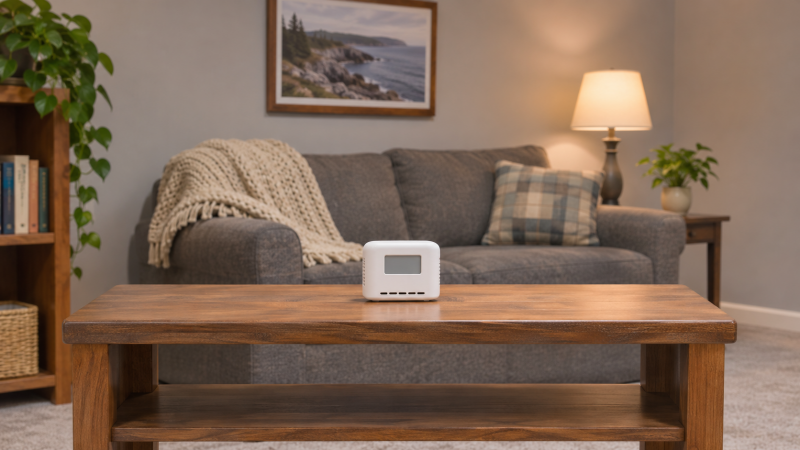
I don’t offer radon testing at Rocky Shores Home Inspection, and I want to explain why. I’m usually in a house for a few hours. That gives me time to look at the roof, check for signs of water getting into the basement and explain what needs attention. It doesn’t give a radon detector enough time to tell you what you’re likely to be exposed to while living there. I’d rather explain that up front than charge for a quick reading that might give you the wrong impression.
What a quick reading actually tells you
Radon is a naturally occurring radioactive gas that can enter a house from the ground. You can’t see it or smell it. A clean, dry basement can have elevated radon just as easily as one with visible cracks. Long-term exposure to elevated radon increases the risk of lung cancer, which is why I recommend testing even when the inspection goes well. Health Canada: What you need to know about radon
Radon levels can change with the weather, the season, and how you heat and ventilate the house. A monitor might give you a low reading while I’m there and a much higher average over the winter. The reverse can happen too: one high reading doesn’t tell you what your average exposure is. The monitor can be working perfectly and still give you a number that’s misleading if you treat a few hours or a few days as the long-term result. Health Canada: Making sense of monitor readings
If an inspector offers radon testing, ask how long the unit stays
Some inspectors offer a separate radon measurement service. If they leave a suitable device in the right place, run it for the recommended period and report the long-term average, that’s a different service from taking a reading during a home inspection. Leaving the unit in the house for the recommended time is part of getting a result you can use.
Before paying for an add-on, I’d ask three questions:
- How long will the detector stay, and how much of that time will be during the heating season?
- Where will it go, and who will make sure it stays in place?
- Who will interpret the result, and are they certified to measure radon through the Canadian National Radon Proficiency Program (C-NRPP)?
If you’re being told you’ll have an answer by the end of the inspection or in a couple of days, ask what that result can actually tell you. I wouldn’t use it to rule radon out or make a decision about mitigation.
How I’d recommend testing your home
- Ask for previous results. If you’re buying, ask the seller for any long-term report and check when, where and for how long the test ran. If there’s no useful report and closing is too soon for a long-term test, put it on your move-in list.
- Use a long-term test kit or a certified measurement professional. Health Canada recommends testing for 3 to 12 months, with at least 91 days during the heating season. You can start earlier in the year and keep testing into the heating season.
- Choose a room you actually use on the lowest lived-in level. A basement bedroom, family room or home office may make sense. If the basement is only used for storage, test on the lowest floor you regularly live on instead. Follow the device instructions, leave it in place and use your home as you normally would.
- Act on the long-term average. If it’s above 200 Bq/m³, Health Canada recommends lowering the level within one year, sooner at higher levels. A certified radon mitigation professional can explain the options. Test again after the work to make sure it helped. If you get a low result from a test that didn’t include 91 days of the heating season, Health Canada recommends retesting during the next heating season. Health Canada: Home radon measurement guide · Reducing radon in your home
When I inspect a house, I tell you what I found, why it matters and what you can do about it. With radon, the most useful advice I can give you is to test the home separately and give the detector the time it needs. I wouldn’t want you to cross radon off your list because somebody handed you a number on inspection day.
Michael Winowich, Rocky Shores Home Inspection
Add comment
Comments